- Published on
Beyond Taxing the Rich: How We Actually End Scarcity
- Authors

- Name
- Johanness Nilsson
- Mastodon
Bernie Sanders stood in the Bronx today in front of a crowd that had earned the right to be angry. Watch the rally.

Last night I re-watched Sidney Lumet’s Network (1976). In it, a newscaster named Howard Beale has a breakdown on air, announces he’ll kill himself on live television, then changes his mind and tells his audience something else entirely: ”I’m as mad as hell, and I’m not going to take this anymore.” He tells them to go to their windows and scream it into the night. And they do. In cities across the country, people open their windows, lean out and scream;
We’re as mad as hell, and we’re not going to take this anymore!
Bernie's Bronx rally felt like that. The energy was real. The anger was earned. And that is exactly what made it uncomfortable to watch, knowing what Lumet shows us next: within weeks of newscaster Howard Beale’s breakdown, the network had turned it into a prime-time show. His rage became a product. Executives fought over his contract. They tracked his ratings like weather. They didn’t silence him. They packaged him. That’s the part Chayefsky wanted us to sit with. This is a magnificent piece of filmography. One of my favorites.
Anyways, Back to the rally — After the Senator was able to quell the audience screams and appllause he applied his formulaic talking points and laid out the math with the plainness that only Sanders can muster without sounding absurd. In the United States, 938 billionaires sit on enough concentrated wealth that a 5% annual tax on that wealth alone would cover housing for every homeless person in the country, expand Medicare to include dental and vision for every American citizen, and fund universal childcare from birth. All three. Simultaneously. This is not a fantasy. It is just simple arithmetic.
Senator Sanders is right. This policy is achievable. The money exists.
Then he named the obstacle, as he always does, and as he's always right about that too. The increasingly consolidated corporate media that doesn't cover this – is owned by billionaires. The Congress that won't pass it has been purchased by the very people it would tax. The oligarchs threatening to relocate if taxed are the same people who spent decades building the regulatory environment that lets them threaten that in the first place. The system isn't malfunctioning. It's performing exactly as is was designed.
While I have enormous respect for Senator Sanders for speaking plainly and standing with citizens on these issues, listening to his speaches give me a growing unease about all of the things that he's still not saying.
An Architectural Problem
It's my opinion that Sanders' redistribution-via-taxation cannot solve the fundamental problem on its own: Once captured via taxation, the money still has to be pushed through the institutions the oligarchs already control.
Win the political battle, pass the wealth tax, watch what happens next. The money gets managed by the same Treasury Department that's been pressured, defunded, and restructured over decades. It gets distributed through agencies whose budgets are held hostage every two years by a Congress that has never fully disentangled itself from donor interests. It gets administered by contractors that are often subsidiaries of the same wealth extraction apparatus that was just taxed.
So the problems aren't just that power is concentrated at the top. It's that the mechanisms for moving that power downward are themselves controlled from the top. It is inherent in the architecture. And architecture has to be changed architecturally.
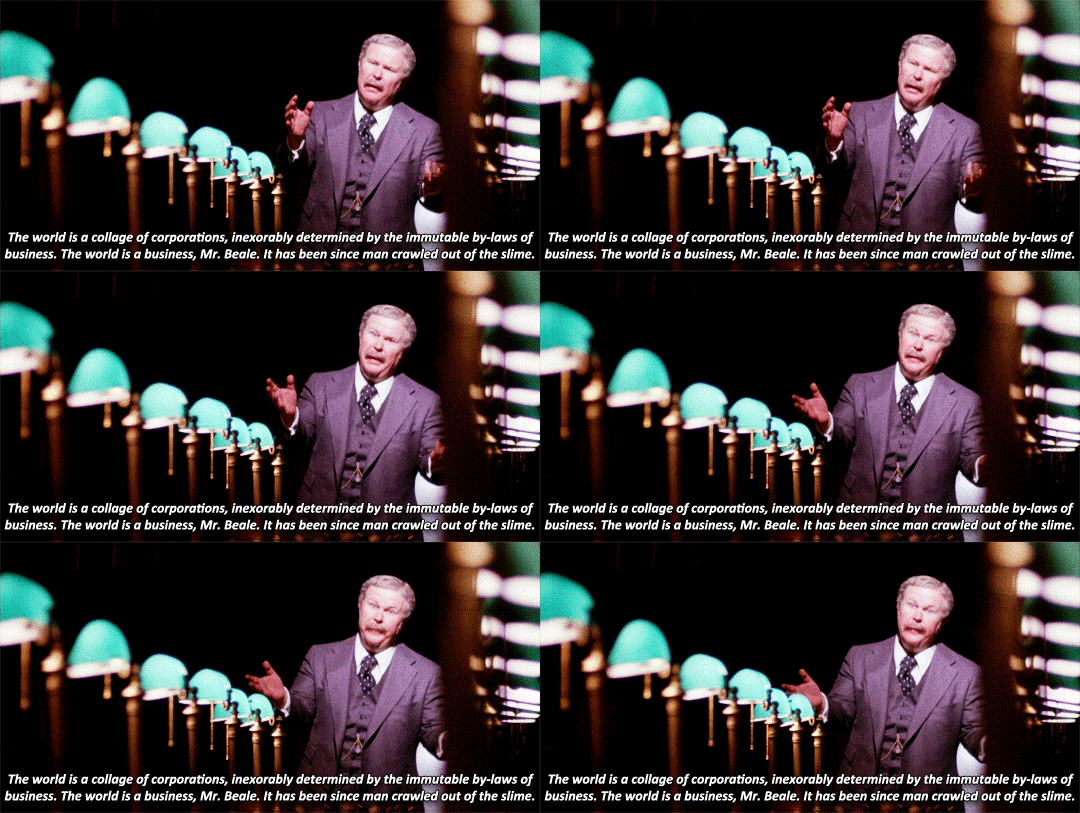
Network's sharpest scene isn't Beale's "Mad as Hell!" rant. It's what happens after. Network executive Arthur Jensen summons Beale to a vast, darkened boardroom and delivers what amounts to a capitalist sermon:
You have meddled with the primal forces of nature, Mr. Beale, and I won't have it... There are no nations. There are no peoples... There is only one holistic system of systems, one vast and immane, interwoven, interacting, multivariate, multinational dominion of dollars.
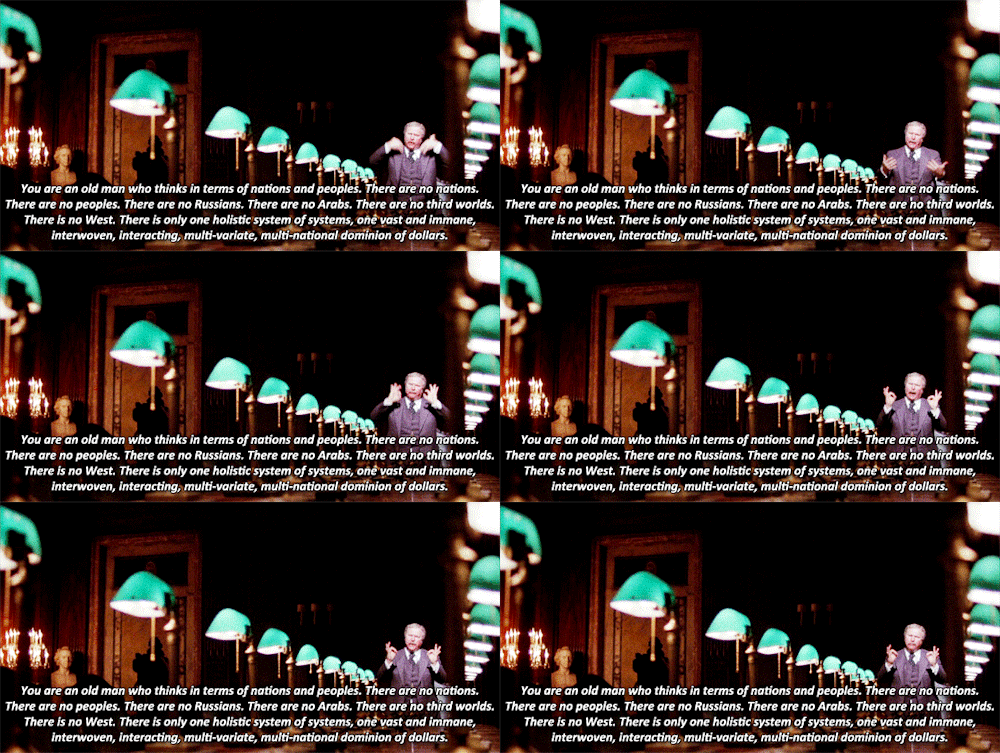
Jensen doesn't threaten Beale. He converts him. He explains, with perfect clarity, that the system isn't broken — it is performing exactly as designed. And Beale, stunned into revelation, goes back on air and begins preaching Jensen's gospel. The anger has been neutralized. The revolutionary has become a mouthpiece. Lumet filmed this in 1976. It has not stopped being true.
Scarcity Is a Choice
I wrote about this at length in my essay on the Epstien Economy. We are not poor because we can't produce enough. We produce extraordinary quantities of food, housing material, energy, medicine, and compute. The scarcity most people experience isn't a natural limit; it's an engineered condition.
It is maintained through intellectual property law that keeps medicine expensive by design. Through land ownership law that allows a small class of people to do nothing while the earth they hold appreciates around them. Through financial systems that make capital available cheaply to those who have it and expensively, if at all, to those who need it. Through regulatory capture that is designed around consolidation and protects incumbent industries from the very competition that would drive down prices.
Bernie's statistic — twelve individuals hold more wealth than the bottom four billion people combined is not a story about extraordinary productivity at the top. It is a story about extraordinary enclosure. The commons of our land, knowledge, radio spectrum, minerals, water, the atmosphere itself; have all been systematically converted into private assets over centuries. What looks like abundance for a few is the shadow of subtracted abundance for all the rest of us.
Tax the billionaires? Yes! But also understand: they didn't get there because the market rewarded their genius. That's a nice little story lie. Not hardly! They got there because they mastered the rules of enclosure. And enclosure has to be reversed at the structural level, not just taxed at the margins. Senator Sanders sorely misses this point.
The False Death of the Programmer
The message going out to young people right now is: don't bother learning to code. AI can already do it. The average software engineering job is disappearing. The CEOs are saying it out loud. Recently, I stood in an all-hands meeting, while a start-up CEO told a room full of young engineers on his VC backed payroll:
— "I spent twenty years getting damn good at code, and I'll probably never write another line again."
And this narrative has powerful amplifiers. It is being repeated by VCs, by tech journalists, by the kind of people who get invited on podcasts to explain what's coming. The herd is moving fast in a single direction: coding is over, move on, learn to prompt. A dangerous herd to roll with.
It is my opinion that this is one of the most dangerous lies of this moment.
What Senator Bernie Sanders is Missing Entirely
I spent twenty years as a Software Engineer. Before I understood what I was doing, I spent most of that time on the things AI will absolutely replace: CRUD endpoints, issue-driven feature work, the twenty-third variation of the same dashboard, database migrations and API integrations that are essentially transcription with syntax. So much of the SWEs time is spent in implementation rather than a craft of architecture.
Now when I look back at it — the work that really mattered was never any of that. The work that mattered was deciding what to build. Deciding how it would govern itself. Deciding who it would serve and who it would exclude. And then encoding those decisions in a system that would outlast any individual engineer.
The more I learn about the past, the more it is evident that the cypherpunks understood this. The cypherpunk movement always understood that the adversary is not monolithic. The people who built TLS/SSL, PGP/GPG, Bitcoin, Tor, Signal, and Smart Contracts were not just engineers writing clever code. They were architects of power structures. Each of those projects was a worldview made executable. PGP said: private communication is a right, not a privilege granted by institutions. Bitcoin said: the issuance of currency should not require trust in a central bank. Tor said: surveillance infrastructure should not be able to track you. Signal said: the state should not have a backdoor into your conversations. Smart Contracts said: agreements should not require trust in courts, lawyers, or states to be enforced.
The worldview made executable there is possibly the most important. It said that contract law which is one of the oldest and most foundational instruments of institutional power, can be replaced by deterministic code running on a network that no single party controls. My hero – Nick Szabo – a cypherpunk coined the term in 1994. He framed it so explicitly: the costs and coercions embedded in traditional legal contracts could be moved into mathematics. Decades later when Ethereum operationalized this at scale, it extended Bitcoin's trustless logic from "store and transfer value" to "execute arbitrary agreements" — which is a much larger surface area of human coordination. Property transfers, organizational governance, financial derivatives, insurance triggers or anything that currently requires an institution to act as enforcer becomes, in principle, a program that enforces itself. The social ramification is that it reorders the intermediary layer of civilization: the class of institutions whose primary function is to be trusted third parties between contracting humans.
The work that all of these cyphers began decades ago – today, is still nowhere near finished.
Future Architects or Typists
I see the choice in front of every person currently deciding whether to invest their life in computer science as this: either programmers write the protocols of abundance, or someone else writes the protocols of control.
AI destroying the average software engineering job is not an argument to abandon the field. It is an argument to go deeper — into cryptography, into distributed systems, into open hardware, into the unglamorous and often poorly-paid work of building infrastructure that doesn't have a private owner. The Start-up CEO can stop writing code, but the fact remains that our world urgently needs more ethical cyphers — not fewer.
Because the question isn't whether powerful systems will be built. They will be built. Guarnanteed. The question is who builds them and for whom. Right now, the answer to both parts of that question is trending in what I percieve as a very bad direction.
Embodied AI and the Question of Ownership
Senator Sanders mentioned something that almost slipped by: the oligarchs are pushing AI and robotics, and it "will be disastrous for the working class." He said it as a side note in his speech about wealth taxes. I think it deserves to be the headline.
Here's my structural argument in plain terms. We are entering an era of embodied AI — robots that can build more robots, manufacture goods, build things and provide care. For the first time in human history, the means of production can be substantially automated. The question of who does the work is about to become, at least in part, a question of who owns the machines that do the work.
If the robot fleets are owned by the billionaires and their successors, we get neofeudalism — not metaphorical feudalism, but a functional revival of the economic structure where most people depend for their basic survival on the goodwill of a small class of lords who own the productive capacity of the land. Except the land is now compute and robots and the energy systems that power them.
If the robots are owned collectively — governed by open protocols, their output distributed as a commons — we get post-scarcity. Not utopia. Just an end to the artificial management of abundance that I described above.
The difference between those two futures is entirely architectural. Not technological. The technology is guaranteed to exist either way. So, the question is: who owns it?
This is the gap in Senator Bernie Sanders argument, and it is a significant one. A 5% wealth tax on the billionaires of 2026 does not answer the question of who will own the robot fleets of 2036. If we win the tax battle and lose the ownership battle, we will have redistributed wealth into a world where the mechanisms for generating it have already been privatized beyond recovery.
What Ending Oligarchy Actually Looks Like
My point in writing this is to be concrete. This is not a utopia pitch. But I want to be more specific than "tax billionaires and hope for the best," so let me try to name the pieces — drawing on some prior writing where I've gone deeper on each of them.
The first thing to understand is that the bottleneck was never production. I argued this at length in The Epstein Economy: we already produce enough food, housing material, energy, medicine, and compute to provide for every human being on earth. The scarcity is managed. What embodied AI and robotics will do is collapse the marginal cost of production further, across more domains, faster. That solves nothing by itself. Because once marginal production costs approach zero, the question stops being "can we make enough?" and becomes purely "who controls access?" That is a distribution problem. And distribution, unlike production, can be engineered at the protocol layer.
Here is the fork I keep returning to, which I laid out in detail in Unemployed For Life: two answers are currently being written for that distribution problem. The first is platforms and permissions — a handful of companies own the infrastructure, meter access through subscriptions and API calls, and capture the surplus. This is the default trajectory and is already well underway. The second is ownership and exit — not symbolic ownership, not a governance token you cannot do anything with, but cryptographically enforced stakes in the systems that generate value. If AI models are trained on the collective output of human civilization, the returns from that automation can be routed, by design, back to the people who generated the training data. Not through benevolence. Not through tax policy that takes twenty years to pass and another ten to enforce. Through protocol design. Through math.
Someone always brings up universal basic income here. A stipend distributed by the same institutions that failed to manage this transition isn't liberation — it is dependency wearing a progressive mask. It still requires captured institutions to faithfully transmit value downward, which is precisely what they are structurally not designed to do. What you want is a system where participation itself generates yield. Where the rules of compensation are embedded in the infrastructure, not in some politician's platform or corporation's terms of service. That is the DAO architecture — organizations with transparent rules, auditable treasuries, and incentive structures defined by code rather than charisma. Dividends instead of wages. Participation instead of employment. Early DAOs were clumsy, and some deserved to fail. But the architecture is correct.
The Epstein Economy points at the other dimension of this. I argued there that accountability has to be structural — embedded in the infrastructure itself — rather than contingent on whether powerful people choose to self-police. The Epstein network ran for decades because its ledger was hidden and private and its clients were powerful enough to keep it that way. The counter to that is not reforming the people at the top. That has likely never worked at scale. It is making the ledger public by design, by math, in ways that cannot be sealed by a federal judge or bought off by a well-connected attorney. The same principle applies to the ownership structures of the robot fleets: encode the distribution function in the protocol before the first production run, not after the money has already been extracted.
One can rationalize that with machine economies, the rules lock in at deployment. By the time someone notices the distribution function is wrong, the system is ten million transactions deep and running at a speed that makes democratic deliberation look like geological timescales. We are in the window right now. The autonomous agent economy does not exist yet in its mature form. The governance architecture of the robot-owned future is still being written. That is not comfortable. But it is a window.
Open-source robotics and compute infrastructure governed by open protocols. Land value taxation that eliminates speculative enclosure. Universal basic compute — not income, which still assumes you consume while someone else produces, but universal access to the tools of production. Public AI models trained on public data as public utility, with governance embedded in the protocol rather than delegated to a board. None of this is speculative science fiction. The technology exists. The policy precedents exist. What doesn't exist yet is the political coalition that understands all of it as one problem.
The gap that actually needs closing is not primarily legislative — it is cultural. The people who understand the protocol layer do not, as a rule, show up to rallies in the Bronx. The people at the rally do not, as a rule, know what a DAO is or why the governance architecture of a robot fleet matters more than its functionality. These are two halves of the same movement that have never been properly introduced.
So: if you are a programmer, go to the rally. Understand what the political fight is actually about before you retreat into building. Your technical fluency is not an excuse to skip the part where you explain it to people who are already angry and already organized. If you are a political person, learn enough about the protocol layer to hold someone accountable when they say "open source" or "democratic governance" without specifying what that means in practice. Vague commitments to openness are how the Jensen boardroom operates in good faith branding. We must stand together and demand specifics.
Contact your representatives — yes, do that, it matters — but also find the people in your city who are already working on the unglamorous infrastructure: the reticulum mesh network project, the hacker-space, or the housing co-op exploring DAO governance, the open-hardware robotics collective, the local DSA chapter that actually has a tech policy working group. These communities exist and they are under-resourced and under-connected to each other. The political coalition that understands this as one problem will not be assembled by a think tank. It will be assembled in conversations between groups who currently use completely different vocabularies to describe the same common challenges which they all are eager to overcome.
We Need Cyphers
Senator Sanders is right that the oligarchs must be confronted. The wealth tax is real and achievable and morally correct. The political fight to pass it is worth having, even knowing how damned hard it is gonna be, even knowing the billionaires will spend whatever it takes to stop us. You fight that fight because the alternative is not fighting it.
But the confrontation doesn't end with a tax bill. It ends when the infrastructure of abundance is no longer posible to withhold. It ends when the protocols that govern what gets built, who owns it, and how it is distributed are free and democratically governed rather than privately held. It ends when the systems that will automate the physical world are commons, not fiefdoms.
The people who build that infrastructure are programmers with an ethical political vision. Not coders looking for a well-paying job in a stable stagnant industry — that job is going away, and I say good riddance to it! But engineers who understand that the alternative to them writing the protocols of abundance for humanity is that someone else writes the protocols of suppression, capture and control.
Let's return to Senator Bernie Sanders' warning:
AI and robotics will be disastrous for the working class.

I want to complicate that.
AI and robotics will destroy the working class, and in a just world, that is exactly what they should do. Not the people. The condition. The broken back. The mind-numbing shift. The warehouse floor that feels indistinguishable from a prison yard. The forty years of CRUD endpoints. The dangerous factory or mine. If machines can absorb the grinding work that capitalism has always required humans to perform under threat of starvation, then we are — for the first time in human history — within reach of something that has never existed at this scale: free time. Time to learn, to build, to think, to care for each other without requiring an employer's permission.
It is only disastrous if we allow the productivity gains to be captured — as they always have been — by whoever owns the machines. That is not a technological inevitability. It is a political / architectural choice. And that choice is being made right now, quietly, inside the ownership structures of every major AI lab and robotics company on the planet.
So what happened to the newscaster turned corporate evangelist Howard Beale? When his ratings finally slipped. After the anger became banal and stopped generating ad revenue. That was when the network executives conspired and had him shot on live television. "The first anchor killed because of lousy ratings." Lumet's closing joke and Chayefsky's indictment.
Beale's failure wasn't his diagnosis; his diagnosis was correct in every detail. His failure was his platform. He was trying to dismantle a system from inside its own most powerful distribution channel, and when he stopped being useful to that system, the system removed him.
The cypherpunks drew a different lesson. They didn't go on television. They didn't try to win control of the channels the adversary owned. They wrote protocols. When Phill Zimmermann published PGP in 1991, the government tried to prosecute him for exporting munitions but soon after found out that you cannot unring that bell. The code was already out.
Sanders is right to be on the stage. The tax fight is real and it is worth having. But the stage is not enough. Beale had no protocol layer. The difference between neofeudalism and post-scarcity is not who wins the next election — it is who writes the next infrastructure. That work belongs to mathematicians and software engineers with political vision.
The world needs more cyphers.