- Published on
The Million Dollar Knowledge Gap: Why I'm Open-Sourcing My Machine Shop Wisdom
- Authors

- Name
- Johanness Nilsson
- Mastodon
The difference between screwing around and science is writing it down.
— Adam Savage
If you've ever tried to drill 5 evenly-spaced holes around a circle, you know exactly why I'm writing this. If you haven't, let me save you some pain: it's where elegant mathematics collides with shop floor reality, and reality always wins.
Actually, let me back up. I know this particular pain intimately because I once decided—in what can only be described as a fever dream of automotive obsession—that my 1962 Mercedes-Benz W110 190D absolutely needed to wear 1990s Mercedes monoblock aluminum wheels. Not just any wheels, mind you, but the specific AMG-style monoblocks that came on the W124 500E—that Porsche-built super sedan from the Bush Sr. era that rolled on the iconic "Gullideckel" wheels.

These weren't your garden-variety rims; they were the distinctive 15-hole, flat-faced alloy wheels that defined Mercedes-Benz in the late '80s and early '90s, nicknamed "manhole covers" because some German engineer apparently looked at street drainage covers and thought, "Yes, this is exactly what our luxury cars need."
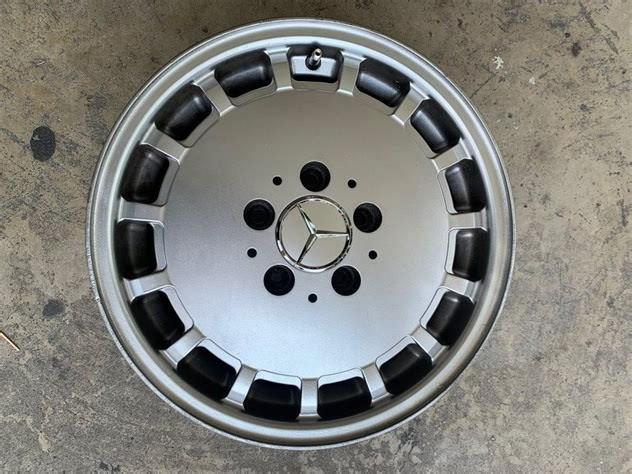
 I needed them because I'm the kind of weirdo who thinks a 40-horsepower diesel sedan built during the Kennedy administration deserves the same rolling stock as this automotive masterpiece. Some people call it auto sports, but I know it's actually called Autism.
Here's the thing about being probably the only human on Earth with this particular flavor of auto-ism: nobody makes adapters for this. Nobody. Because who else would look at a car that takes ≥37 seconds to reach 60 mph and think, "You know what this needs? Wheels that were designed for Autobahn cruise missiles."
But I had a vision. And access to time shares on CNC mills. And more importantly, I had the kind of stubborn determination that makes you spend three weeks figuring out how to perfectly adapt a wheel bolt pattern from 1962 to wheels from 1992, because Mercedes changed the hub bore, the offset, and literally everything else except the 5x112mm PCD (Pitch Circle Diameter) in those 3 decades.
The Problem (That I Created for Myself)
Here's what every engineering textbook tells you: 360° divided by 5 equals 72°. Simple. Clean. Done.
What I imagine they don't tell you: when you're standing at a mill at 2 AM on a work night, trying to position those holes in a custom aluminum spacer that needs to perfectly mate two different generations of German engineering—while maintaining proper hub-centric fitment because you're not a complete barbarian—you're working with coordinates like:
Hole 1: (0, R)
Hole 2: (R×sin(72°), R×cos(72°))
Hole 3: (R×sin(144°), R×cos(144°))
Hole 4: (-R×sin(144°), R×cos(144°))
Hole 5: (-R×sin(72°), R×cos(72°))
Unlike 4, 6, or 8-hole patterns that give you nice round numbers or simple fractions, 5-hole patterns force you into irrational number territory. It's sin(72°) = 0.95106, and no, that's not going to simplify nicely. And when you're trying to hold tolerances tight enough that a German wheel from the era of "Rhythm Is a Dancer" will center perfectly on a hub designed when "Moon River" was topping the charts, every decimal place matters.
I think I spent two solid week nights just figuring out the proper math. Not because I couldn't do the math—I can calculate sin(72°) in my sleep at this point—but because I kept second-guessing myself. When you're about to drill into a $200 mill cut of 6061 aluminum round, and you know that one misplaced hole means starting over, you check your math. Then you check it again. Then you have an existential crisis about how food would probably be a better way to spend your money, and whether you really understand the unit circle. Then hungrily, I checked it a third and fourth time.
Why This Obsessive Precision Actually Matters
You might think this level of obsession over wheel adapters is excessive. And you'd be right. But my manic attention to detail—my refusal to accept "close enough" when precision is possible—is exactly what's needed when you're trying to revolutionize energy production.
Today I'm at Terraform Industries, where we're building machines that literally pull fuel from thin air. We're converting sunlight, water, and CO2 into natural gas through processes that would make your thermodynamics professor weep with joy. The engineering involved is legitimately rocket science levels of complicated. But you know what all those brilliant chemical reactors, heat exchangers, and pressure vessels have in common? They're held together with bolts. In holes. That someone had to drill. Precisely.
The difference is, when a wheel adapter is off by a few thousandths, the car vibrates a little. When a pressure vessel flange is off by a few thousandths, well… let's just say the consequences can involve more paperwork and fewer fingers. The stakes are higher, but the fundamental challenge remains the same: turning theoretical perfection into physical reality.
We live by a simple truth: the fastest path to breakthrough innovation is through rapid physical iteration. Not endless modeling, not perfect simulations, but actual hardware that we can test, break, learn from, and improve. And when your iteration speed is limited by how fast you can turn ideas into testable prototypes, every bit of practical knowledge matters.
My Mercedes wheel adapter saga taught me this lesson years before I joined Terraform. Those adapters? They worked. Perfectly. My '62 now rolls on period-incorrect but aesthetically perfect 1990s monoblocks. But more importantly, the process of making them taught me that the gap between "I know the math" and "I can make the part" is vast, treacherous, and filled with expensive scrapped aluminum and countless broken end mills.
The Documentation Gap
I'm not a classically trained millwright, and I would hesitate to associate as a machinist. I'm a hacker who learned by doing, breaking things, and most importantly, by documenting both successes and spectacular failures. Every crashed tool, every scrapped part, every "that's not how that works" moment became part of my dataset.
After years of accumulating this knowledge—and months spent recently watching all these brilliant engineers who surround me, often contending with the gap between theory and practice—I realized something: we're all solving the same problems, making the same mistakes, learning the same lessons. But we're doing it in silos. We're struggling in isolation.
Think about it: somewhere right now, someone is standing at a mill, trying to drill 5 holes and a center hub bore, doing the same trigonometry I did, having the same crisis of confidence, making the same mistakes. They're probably not making Mercedes wheel adapters (because again, that level of specificity is probably unique to my particular brand of obsession), but they're fighting the same fundamental battle between theoretical knowledge and physical reality.
So I started writing it down. All of it. The tribal knowledge that usually takes decades to accumulate:
- Edge finding techniques — because "close to the edge" isn't a measurement
- Dial indicator mastery — the difference between indicating and actually indicating
- Speeds and feeds — why your tool is screaming and how to make it stop
- Work holding methods — because physics doesn't care about your intentions
- Surface finishing — from "good enough" to "actually good"
- Compound angles — when one axis of confusion isn't enough
Each tutorial exists because I've personally screwed it up, figured it out, and realized someone else is going to face the same problems.
A Transformation
Here's what happens when you bridge the theory-practice gap: people start designing differently. They iterate faster. They try crazier ideas because they know they can test them today, not next month.
Competence is contagious. When we see colleagues confidently turning ideas into hardware, everyone wants that superpower. The building bug spreads through teams like wildfire. Suddenly, "let me try something" leads to immediate action, not hours of technical meetings.
It's the same phenomenon I've experienced before. Once I successfully made those wheel adapters—once I proved to myself that I could take an absurd idea and manifest it in aluminum—everything changed. Suddenly, every weird idea becomes possible. Custom electric drive-train conversions? Sure! Bespoke transmission brackets? Absolutely! Adapter plates to merge a Toyota / Lexus electric drive unit with a 1960s Swing-Arm rear differential? Already done!
Why Open Source?
It's well known that Millwrights in traditional machine shops guard their knowledge like state secrets. But we're not trying to corner the market on machining wisdom—we're trying to solve climate change. If my tutorials can help another hard tech startup iterate faster, that's a win for all humanity in my book.
Think about it—if historical innovators like Edison had Git and GitLab, they could have version-controlled their 10,000 failures. Instead of hoarding knowledge in personal notebooks, they could have collaborated across continents. Today we have that opportunity. We can share our successes AND our failures, let others fork our mistakes and merge their improvements.
Because at the end of the day, hardware is hard enough without artificial barriers. And saving the world is going to take every advantage we can get—including knowing that sin(72°) = 0.95106, and that you should probably just use 6 holes instead.
(Seriously, use 6 holes. Your future self will thank you. Unless you're adapting vintage Mercedes wheels, in which case you're stuck with 5, and you deserve the suffering you've signed up for.)
The Spiral-Bound Origins
Ever since childhood I've been documenting my mechanical adventures. Long before the Mercedes wheel obsession, and long before Terraform. It started when I was maybe six or seven years old, and Mom made the critical error of giving me an expensive radio-controlled monster truck for a birthday gift. While other kids would have been jumping it off ramps and racing it up and down the driveway, I found a screwdriver set and methodically disassembled the entire thing. Not because it was broken—It was new and it worked perfectly. I just needed to know HOW it worked to be able to fully enjoy it. For me‒enjoyment in life comes through thoroughly understanding how and why things work.
This approach works great with machines. Less so with people. You can't take people apart to understand them, and even if you could, I'm pretty sure it's illegal. Plus they never seem to come with service manuals or wiring diagrams, and they are next to impossible to reassemble.
I still remember the panic my poor Mother experienced when I couldn't figure out how the plastic gears in the differential went back together. I cried and she had no consolations to offer. I took it apart, and that was the end of the RC Monster-Truck. But all was not lost. Because I filled my notebook. I sketched every gear in crayon, every bushing, every mysterious spring whose purpose my seven year old mind could not divine. Long after the other kids RC truck batteries were dead, or the toy broken, I was transfixed, filling my notebook with every intricate detail of the toy's design, as I tried to grasp its function. That spiral bound notebook was one of many.
That panicked kid trying to reassemble a differential grew up to be someone who documents everything—not because anyone asked me to, but because I physically cannot NOT document it. It's compulsive. It's who I am.
Documentation Evolution
The documentation evolved with the technology. Started with spiral-bound notebooks through the '90s. Then around 2000, I discovered the power of digital documentation—first Emacs, then Vim, because why use a mouse when you can keep your hands on the keyboard? Suddenly I could grep through years of notes, cross-reference failures with successes, build my own knowledge base that grew with every project. PS: ripgrep! Welcome to 2025!
A laptop became as essential as any tool in the shop. I'll have vim open in one terminal, FreeCAD in another window, and usually some forum post about why someone else's similar project exploded. Every experiment gets its own set of files. Looking back‒my file names alone tell the stories of my many frustrations and breakthroughs.
The Universal Knowledge Gap
My 5-hole pattern documentation became a tutorial. It is just one of the chapters in what's become an encyclopedic collection of hard-won knowledge. Because here's what I've learned after tens of thousands of hours of figuring out how stuff works: everyone hits the same walls. The intern trying to find the edge of their workpiece is having the same crisis I had when I discovered that "eyeballing center" is a recipe for scrap. They're learning what I learned the hard way—like that spindle speed isn't just a number, it's a contract between your tool and the material you're working with.
We're all just trying to turn ideas into reality, and reality has very specific, non-negotiable requirements that nobody teaches you in school. Theory says "apply force F to achieve result R." Reality says "apply force F at the wrong angle and your part becomes a projectile, your tool becomes shrapnel, and your day becomes painful and expensive."
The gap between knowing something should work and knowing how to make it work shows up everywhere:
- Edge finding — Theory: touch the edge. Practice: which edge? How do you know when you've touched it? What if the edge isn't straight?
- Speeds and feeds — Theory: calculate from material properties. Practice: your calculation assumes a perfectly rigid setup, and yours isn't.
- Work holding — Theory: clamp it down. Practice: where? How tight? What happens when the tool pulls?
- Surface finish — Theory: finer passes = smoother surface. Practice: sometimes finer passes make it worse.
Each tutorial exists because I've personally screwed it up, figured it out, and realized someone else is going to face the same problems.
Work With Us
Hey! Are you the kind of person who wants to know both the theory AND the practice? Terraform Industries is hiring engineers and hackers who understand that the best ideas are the ones you can actually build. Drop us a line at hiring@terraformindustries.com with evidence of something you've made. Bonus points if it's something nobody asked for but you built anyway because your vision demanded it!
The complete Machine Shop Tutorials are freely available at github.com/JoNilsson/machine-shop-tutorials. Everything from basic tool use to advanced techniques, written in plain English by someone who's made every dumb mistake so you don't have to. MIT licensed because the future is too important to gatekeep.